Bonjour!
Sharing the Planet (Partage de la planète) is one of the five prescribed IB French global themes and one of the most tested across all components of the exam.
This guide gives you complete IB French B Sharing the Planet vocabulary organised by sub-theme and level, key grammar structures, Paper 1 preparation, a model oral answer, and connections to the French-speaking world.
Expert IB French tuition — Ab Initio, Standard Level and Higher Level
For personalised preparation across all five IB themes — including Sharing the Planet — visit our IB French tuition page or contact us directly.
What Is IB French B Sharing the Planet?
Sharing the Planet covers the relationship between human societies and the natural world. It encompasses climate change, biodiversity, sustainable development, food security, human rights, globalisation, migration, and urban and rural challenges. The key sub-themes are:
- The environment and climate change — l'environnement et le changement climatique
- Biodiversity and ecosystems — la biodiversité et les écosystèmes
- Sustainable development — le développement durable
- Food security and agriculture — la sécurité alimentaire et l'agriculture
- Human rights and social justice — les droits humains et la justice sociale
- Globalisation and migration — la mondialisation et la migration
- Urban and rural challenges — les défis urbains et ruraux
IB French Sharing the Planet — Vocabulary by Sub-Theme and Level
For a complete thematic guide across all five IB themes, see our IB French vocabulary guide.
IB French Environment and Climate Change Vocabulary — L'environnement et le changement climatique
Biodiversity and Ecosystems — La biodiversité et les écosystèmes
Sustainable Development — Le développement durable
Food Security and Agriculture — La sécurité alimentaire et l'agriculture
Human Rights and Social Justice — Les droits humains et la justice sociale
Migration and Globalisation — La migration et la mondialisation
Urban and Rural Challenges — Les défis urbains et ruraux
Key Verbs for IB French B Sharing the Planet
Key Adjectives for IB French B Sharing the Planet
Key Opinion Phrases for IB French B Sharing the Planet
These expressions work for Paper 1 and the oral. For a complete bank, see our guide to opinion expressions in IB French.
IB French Sharing the Planet — Paper 1 Preparation
For a complete guide to all eleven text types and their conventions, see our IB French SL Paper 1 guide.
Key grammar structures for this theme
- Si + imparfait + conditionnel — Si nous réduisions nos émissions, nous pourrions limiter le réchauffement. See our si clauses guide.
- Varied tenses — passé composé for past events, futur simple for predictions, conditionnel for proposals. See our guide to the most commonly used tenses in French.
- Bien que + subjonctif — Bien que les accords existent, leur application reste insuffisante.
- Le conditionnel — Il faudrait investir davantage dans les énergies renouvelables. See our conditional guide.
- Varied connectors — cependant, par conséquent, néanmoins, de surcroît. See our connectors guide.
For the complete grammar checklist: IB French grammar guide.
IB French Sharing the Planet — Model Production Écrite (Paper 1)
Here is an example of a Paper 1 exam prompt on the Sharing the Planet theme, followed by a model text. For all eleven text types and their conventions, see our IB French SL Paper 1 guide.
Sujet (Paper 1 — style examen IB)
Vous êtes préoccupé(e) par l'impact de la consommation quotidienne sur l'environnement et vous souhaitez encourager les membres de votre communauté à adopter des comportements plus responsables. Rédigez un texte dans lequel vous expliquez le problème, décrivez ses conséquences pour la planète et proposez des solutions concrètes.
Blog · Article · Discours
Texte modèle — Blog (≈ 290 mots)
Consommons mieux pour protéger notre planète
Chaque jour, nous faisons des choix — ce que nous achetons, ce que nous mangeons, comment nous nous déplaçons. Ces choix, multipliés par des milliards d'individus, ont un impact considérable sur notre planète. Pourtant, bien que nous soyons de plus en plus conscients du problème, nos habitudes de consommation peinent à changer.
Aujourd'hui, la production de déchets plastiques est l'un des enjeux les plus urgents de notre temps. Selon certaines estimations, plus de huit millions de tonnes de plastique finissent dans nos océans chaque année — menaçant la faune marine et entrant dans notre chaîne alimentaire sous forme de microplastiques. Si nous ne modifions pas radicalement notre rapport à la consommation, les conséquences pour les générations futures seront irréversibles.
Mais alors, que peut-on faire concrètement ? D'abord, nous pouvons réduire notre consommation de plastique à usage unique : remplacer les bouteilles jetables par des gourdes réutilisables, trier nos déchets, acheter en vrac. Ensuite, nous pouvons repenser nos habitudes alimentaires — consommer local et de saison réduit considérablement notre empreinte carbone. Ce qui m'a frappé, c'est qu'en changeant seulement quelques habitudes quotidiennes, on peut réduire son empreinte carbone de 20 % en un an.
À mon avis, la clé réside dans l'éducation. Si chaque école intégrait l'éco-citoyenneté à ses programmes dès le primaire, les prochaines générations grandiraient avec des réflexes écologiques naturels. Ce dont nous avons besoin, ce n'est pas de sacrifier notre confort, mais de faire des choix plus réfléchis.
Il n'est pas trop tard pour agir. Chaque geste compte — et c'est en additionnant ces gestes que nous pouvons faire la différence. La planète n'attend pas.
Structures : bien que + subjonctif · si + présent + futur · si + imparfait + conditionnel · ce qui… c'est · ce dont… c'est · connectors (pourtant, d'abord, ensuite, à mon avis) · vocabulary (déchets plastiques, microplastiques, empreinte carbone, éco-citoyenneté, chaîne alimentaire)
IB French Sharing the Planet — Paper 2 Preparation
In Paper 2 Reading, IB French Sharing the Planet texts are typically drawn from Le Monde, Libération, RFI, Courrier International, 20 Minutes. They cover scientific reports, interviews with activists, articles on sustainable development, or opinion pieces on migration and globalisation. In Paper 2 Listening, expect radio interviews with experts, news reports on environmental disasters, or debates on ecological policy — at natural speed, with varied French-speaking accents.
For full reading and listening strategies, see our IB French Paper 2 guide. For practice under real exam conditions, see our IB French past papers guide.
Reading tip: Read one French article per week on an environmental or social topic — Le Monde Planète, RFI Environnement, Reporterre.net. Note every new word in its sentence context.
Listening tip: Listen to France Inter and RFI Journal daily — exactly the registers and speed used in Paper 2 audio.
IB French Sharing the Planet — Individual Oral Preparation
Typical photos for this theme: polluted beaches, deforested areas, electric vehicles, solar panels, food markets in developing countries, climate protests, refugee camps, urban green spaces, overcrowded cities.
For the full 10-line strategy, see our IB French oral exam guide.
IB French B Sharing the Planet — Francophone Connections
France — Climate Policy and Energy Transition
France hosted the Accord de Paris in 2015 and has committed to carbon neutrality by 2050. Key references: the nuclear energy debate, the loi Climat et Résilience, and tensions between ecological transition and social justice (the gilets jaunes movement). Reference phrase: La France s'est engagée à atteindre la neutralité carbone d'ici 2050.
French Pacific Islands — Sea Level Rise
French Polynesia, New Caledonia, and Wallis-et-Futuna are directly threatened by rising sea levels. Reference: Les îles de la Polynésie française sont en première ligne face à la montée des eaux.
Sub-Saharan Africa — Food Security and Desertification
French-speaking countries — Senegal, Mali, Burkina Faso, Niger — face food insecurity and climate-driven migration. Reference: Le Sahel connaît une désertification accélérée qui menace la sécurité alimentaire de millions de personnes.
Quebec — Sustainable Energy
Quebec produces 96% of its electricity from renewable sources, mainly hydroelectric. Reference: Le Québec produit 96% de son électricité à partir de sources renouvelables.
Common examiner questions — Sharing the Planet oral
- Quelles sont selon vous les principales causes du changement climatique ?
- Pensez-vous que les individus peuvent vraiment faire la différence ?
- Quel rôle les gouvernements devraient-ils jouer dans la protection de l'environnement ?
- Que pensez-vous des réfugiés climatiques ?
- En quoi les pays francophones sont-ils particulièrement concernés par ces enjeux ?
- Que faites-vous personnellement pour réduire votre impact sur l'environnement ?
- Pensez-vous que la transition énergétique soit possible sans sacrifier la croissance économique ?
- Quels sont les défis liés à l'urbanisation dans les pays francophones ?
- Que faites-vous personnellement pour protéger la planète ? Quels gestes éco-citoyens adoptez-vous au quotidien ?
- Pensez-vous que les jeunes de votre génération sont suffisamment engagés pour l'environnement ?
Model oral answer — IB French Sharing the Planet
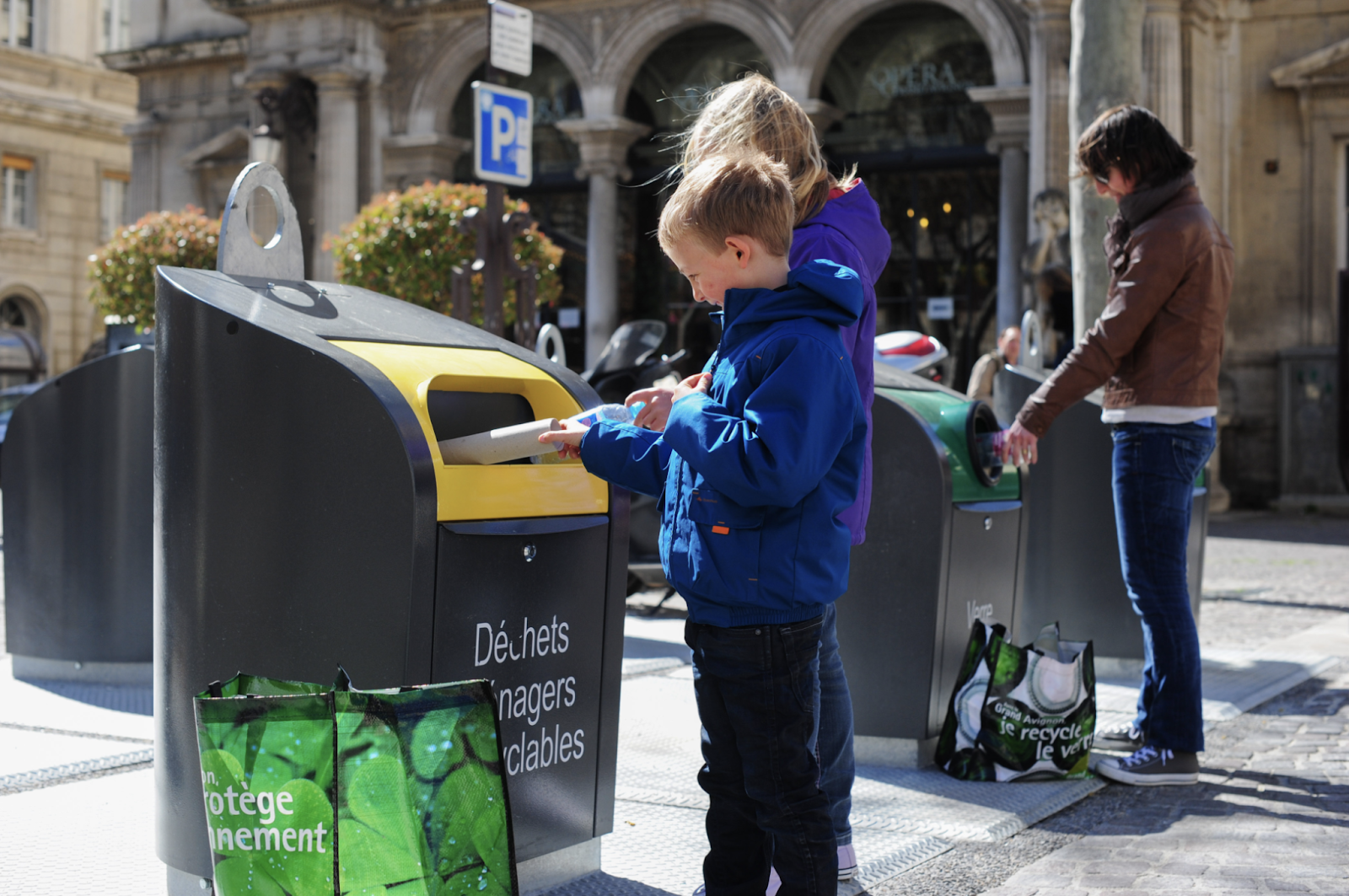
The photo below shows a child recycling in a French city square. Here is a model response using the 3-layer approach:
"Cette photo aborde le thème duPartage de la planète, et plus précisément la question du recyclage et de l'éco-citoyenneté au quotidien.
Au premier plan, on voit un jeune enfant vêtu d'un sweat bleu qui dépose un déchet dans un conteneur de tri sélectif — on peut lire sur la poubelle les motsdéchets ménagers recyclables. Le couvercle jaune indique qu'il s'agit d'un conteneur pour le recyclage des déchets ménagers. Juste derrière lui, une jeune fille semble l'accompagner. À l'arrière-plan, un adulte utilise également un conteneur de recyclage vert, et on aperçoit des sacs verts portant les slogansJe recycleetOn protège l'environnement. La scène se déroule dans une place d'une ville française ensoleillée — on distingue une architecture typiquement française et l'enseigne d'un Opéra en arrière-plan.
Ce qui m'intéresse particulièrement dans cette image, c'est qu'il s'agit d'un enfant qui fait un geste éco-citoyen. Cela soulève la question de l'éducation environnementale et de la transmission des valeurs écologiques dès le plus jeune âge. En France, le tri des déchets est bien ancré dans les habitudes, mais les efforts restent insuffisants pour atteindre les objectifs climatiques européens. Bien que les Français recyclent davantage qu'il y a vingt ans, le chemin à parcourir reste considérable.
À mon avis, il est essentiel d'enseigner les gestes éco-citoyens aux enfants le plus tôt possible, car ce sont eux qui porteront ces habitudes à l'âge adulte. Si chaque citoyen triait systématiquement ses déchets et adoptait une consommation plus responsable, l'impact sur l'environnement serait considérable. Ce dont nous avons besoin, c'est non seulement d'infrastructures adaptées — comme ces conteneurs —mais aussi d'une éducation environnementale solide dans les écoles dès le primaire."
Structures utilisées : au premier plan / à l'arrière-plan · ce qui m'intéresse, c'est… · bien que + subjonctif · si + imparfait + conditionnel · ce dont nous avons besoin, c'est… · francophone connection (France, tri sélectif) · 3-layer approach: description → analysis → opinion
Frequently Asked Questions — IB French Sharing the Planet
What are the IB French oral questions about Sharing the Planet?
The most common examiner questions for this theme are: Que faites-vous personnellement pour protéger la planète ? Quel rôle les gouvernements devraient-ils jouer ? Pensez-vous que les individus peuvent vraiment faire la différence ? En quoi les pays francophones sont-ils concernés ? Prepare 2–3 angles for each — causes, consequences, solutions — and a personal example.
See our full IB French oral guide.
How do I describe a photo about the environment in IB French?
Move through three stages: describe what you see using spatial vocabulary (au premier plan, à l'arrière-plan, au centre), connect the image to the Sharing the Planet theme (cette image soulève la question de…), then give a personal opinion with a developed argument. Never spend more than one minute on pure description — the examiner wants to hear your ideas, not a list of what you see.
See our oral exam guide for the full 10-line strategy.
What should I say if the examiner asks what I personally do for the environment?
This is one of the most common questions — and one of the easiest to prepare. Have two or three concrete examples ready: J'essaie de réduire mes déchets plastiques, je privilégie les transports en commun, je fais attention à ma consommation de viande. Then develop one of them with a reason: Car je suis convaincu(e) que chaque geste compte, même à l'échelle individuelle. Avoid vague answers like je recycle without development.
What is the easiest IB French Sharing the Planet text type for Paper 1?
The blog or article — they give you the most freedom to argue a position without strict formal conventions. But "easiest" means the one you know best: if you know the speech format inside out, a speech on climate change can score higher than a blog written with uncertainty. Master at least three formats before the exam.
See our Paper 1 guide for all eleven text types.
Which French-speaking countries should I mention in the oral for this theme?
At minimum: France (l'Accord de Paris, la transition énergétique), French Polynesia (la montée des eaux menace les îles), and Senegal or Mali (désertification, sécurité alimentaire). One specific fact per country — a policy, a statistic, a place name — makes your oral sound genuine and informed rather than rehearsed.
How do I get a 7 in IB French for the Sharing the Planet theme?
Use vocabulary from the advanced section of this guide (SL and HL tables), include at least one well-argued francophone connection, use bien que + subjonctif and a si clause naturally in your Paper 1 or oral, and always develop your opinions beyond a single sentence.
For a complete strategy across all four components, see our How to Get a 7 in IB French guide.
What Our Students Say
"I had the privilege of working with Laure to prepare for my IB SL exams during year 11 and 12, she helped me a lot, without her I would not have been able to achieve this result. She showed great patience and pushed and encouraged me in each of her classes. Laure is perfectly familiar with the IB program and the expectations of the final exams. She took the time to have me regularly repeat the vocabulary of the themes covered in class, she explained the grammar in a clear and structured way so that I could integrate it into my written tasks. She brought me many resources and in particular many previous papers with which I practised, in particular oral production for which I had a lot of apprehension. In the end, I'm really happy with my overall mark! Thank you Laure!"
Patrick Tan — IB French SL student, Melbourne
"I took Laure's classes for my French IB during my last two years at school. She has in-depth knowledge of the specific requirements of the IB French program, and her ability to clarify complex concepts greatly facilitated my understanding of the language but also of the different themes covered in class. She took the time to understand my specific needs which were mainly in grammar to adapt her teaching methods. Thanks to her continued support during our sessions, I was able to gain confidence in my abilities to speak French and I was able to pass the end-of-year exams with flying colours, particularly the oral exam that I dreaded so much. I highly recommend Laure as an IB French tutor. Her professionalism and expertise were essential assets to my success."
Inga — IB French student, Melbourne
"I started having lessons with Laure in January 2016 as I was having some difficulties at school with my IB French. Our lessons considerably improved my marks and my comprehension of the language. Each lesson, we worked on vocabulary, grammar and we did a lot of exercises too (dictation, writing and comprehension), all of that helped me to achieve some really good marks and I successfully passed my French IB exams at the end of the year! I really enjoyed our lessons and would like to recommend Laure to other students who need support with their French."
Lea Kroot — IB French student, Brussels
"I'm really grateful for all of Laure's support and expertise throughout my IB French journey. I started the year sitting between Band 3 and 4, and finished the November 2025 session with a mid Band 6. This improvement was largely due to the structured lessons and the teaching style Laure used, which really helped reinforce my learning and build confidence in French."
Zeke De Alwis — IB French Ab Initio student, Sydney
Expert IB French Tuition — All Levels, All Themes
At French via Skype, our tutor is a certified native French teacher with over twenty years of experience. Since 2011, she has been preparing students for their IB French final exams at Ab Initio, Standard Level and Higher Level, working with students across Australia (including Melbourne and Sydney), the UK, Belgium, Luxembourg, Paris, Switzerland and beyond.
She trained at the French Institute in London and has been a certified DELF examiner since 2005 — a qualification that reflects her deep understanding of how French language exams are assessed. She has a thorough mastery of the IB curriculum — the assessment criteria, the weighting of every component, and what distinguishes a good response from an excellent one.
For rates and availability, visit our IB French tuition page — or get in touch directly.
À bientôt !

