Bonjour!
Social Organisation (Organisation sociale) is one of the five prescribed IB French global themes and one of the most tested across all components of the exam.
Looking for expert one-to-one IB French tuition?
This guide gives you complete IB French B Social Organisation vocabulary organised by sub-theme and level, key grammar structures, Paper 1 preparation, a model oral answer, and connections to the French-speaking world.
Expert IB French Tuition — Ab Initio, Standard Level and Higher Level
For personalised preparation across all five IB themes — including Social Organisation — visit our IB French tuition page or contact us directly.
Lessons are tailored to Ab Initio, Standard Level and Higher Level students alike.
What Is IB French B Social Organisation?
Social Organisation looks at how individuals fit into groups — families, schools, workplaces, communities and nations — and at how a society distributes opportunity, responsibility and power between its members. It encompasses education systems, work and the professional world, social relationships, law and civic life, public services, inequality, and voluntary engagement.
Because it deals with how people live together, this theme overlaps naturally with the other four IB themes: it touches Identities through questions of belonging, Experiences through rites of passage such as starting school or a first job, and Sharing the Planet through debates on access to resources and public services.
Examiners often expect candidates to move fluidly between these themes, so building strong, transferable vocabulary here pays off across the whole syllabus.
IB French Social Organisation — Vocabulary by Sub-Theme and Level
For a complete thematic guide across all five IB themes, see our IB French vocabulary guide.
IB French Social Organisation — Individual Oral Preparation (Internal Assessment)
Typical stimulus photos for this theme show a classroom, a protest or demonstration, volunteers at work, a crowded public transport scene, or several generations together at a family or community event. As with any theme, the Individual Oral — the Internal Assessment (IA) component of IB French B — rewards candidates who move beyond simply describing the photo: once you have identified what is happening, link it explicitly to the theme of Social Organisation, state a personal opinion, and anticipate a follow-up question the examiner is likely to ask.
For the full structure of the exam, timing, and more tips, see our IB French Oral Exam guide.
IB French B Social Organisation — Francophone Connections
Examiners respond well to candidates who can illustrate abstract ideas with a concrete example from the French-speaking world, rather than speaking only in generalities. The four examples below cover different aspects of how societies organise themselves — education and secularism, local democracy, family-based solidarity and community-run services — so they can be adapted to several different prompts.
France — Laïcité and Public Education
The principle of la laïcité and the public school system (l'école publique) have shaped how French society organises civic life and education, and the debate over how strictly laïcité should apply in schools remains a live political issue.
Phrase-modèle : « En France, la laïcité est un principe fondamental qui vise à séparer la religion de l'État, notamment à l'école publique, où l'on cherche à garantir l'égalité de tous les élèves, quelles que soient leurs croyances. »
Switzerland — Direct Democracy and the Commune
In Suisse romande, direct democracy and the commune (the local municipality) are the first level of civic engagement for most residents, who vote directly on local issues several times a year rather than leaving every decision to elected representatives.
Phrase-modèle : « En Suisse, les citoyens votent plusieurs fois par an sur des questions locales et nationales, ce qui leur donne un pouvoir de décision direct, contrairement à de nombreux autres pays où l'on vote seulement pour élire des représentants. »
Côte d'Ivoire — Family and Community Solidarity
Extended family networks and community solidarity (la solidarité familiale) play a central role in how society organises support outside formal institutions, often filling gaps left by limited state social services.
Phrase-modèle : « En Côte d'Ivoire, la solidarité familiale joue un rôle essentiel : lorsque les services publics sont insuffisants, c'est souvent la famille élargie et la communauté qui prennent le relais pour soutenir les plus vulnérables. »
Quebec — Community Associations
Community associations (les organismes communautaires) in Quebec take on a significant share of social services, from food banks to youth programmes, often in partnership with the provincial government rather than independently of it.
Phrase-modèle : « Au Québec, les organismes communautaires, comme les banques alimentaires, jouent un rôle complémentaire à celui de l'État, en partenariat avec le gouvernement provincial plutôt qu'indépendamment de lui. »
Common examiner questions — Social Organisation oral
- Que voyez-vous sur cette photo ?
- Pensez-vous que le bénévolat devrait être obligatoire pour les jeunes ?
- Quel rôle les associations jouent-elles dans votre pays ?
- Comment la technologie change-t-elle le monde du travail ?
- Pensez-vous que les inégalités sociales augmentent dans votre pays ?
Model oral answer — IB French Social Organisation
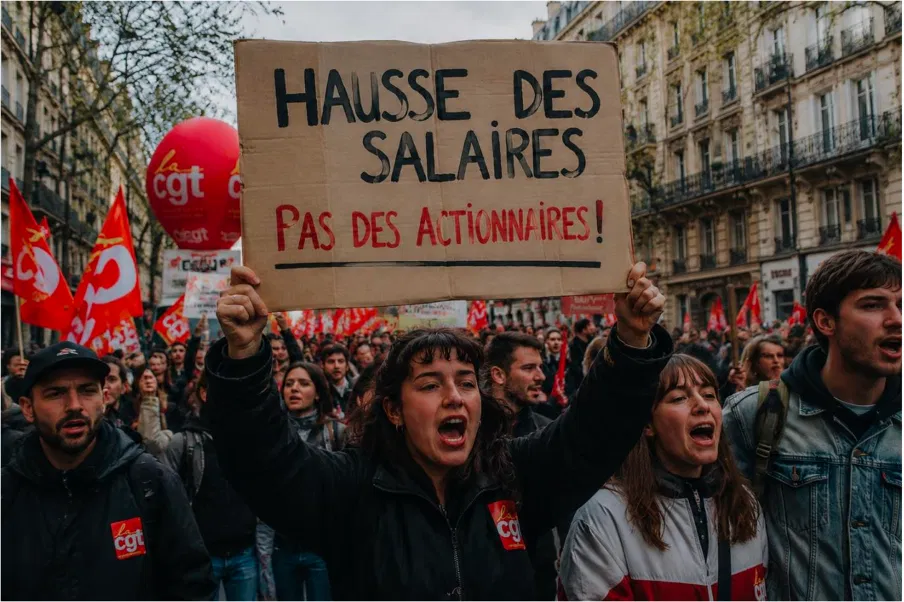
This model answer refers to the photograph at the top of this article — the demonstration in Paris with the "Hausse des salaires, pas des actionnaires !" sign — used here as the stimulus visual. It is structured around the eight questions from the official student worksheet (Individual Oral, Standard Level), using the vocabulary and sentence starters it suggests.
1. Que voit-on sur le stimulus visuel ?
On peut voir une manifestation dans une rue très fréquentée. Au premier plan, on distingue une jeune femme qui lève le poing et qui tient une pancarte en carton sur laquelle on peut lire « Hausse des salaires, pas des actionnaires ! ». Autour d'elle, on peut apercevoir une foule dense de manifestants, des drapeaux rouges et un ballon portant le logo de la CGT, l'un des principaux syndicats français.
2. Où se passe la scène ?
La scène se déroule dans un milieu urbain, probablement à Paris, dans une rue bondée bordée d'immeubles de style haussmannien. On pourrait aussi imaginer que cela se passe dans une grande ville de province, puisque ce type de mobilisation syndicale a lieu dans toute la France.
3. Qui sont les personnages ? Que font-ils ?
On remarque des citadins de tous âges, hommes et femmes, qui semblent être des collègues de travail ou des membres du même syndicat. Ils ont l'air déterminés, voire en colère, et ils sont en train de manifester et de scander des slogans. Ils s'apprêtent visiblement à défiler dans les rues pour faire entendre leurs revendications.
4. Quel sujet ou quel thème est illustré par le stimulus visuel ?
Ce stimulus visuel soulève le problème des inégalités salariales et de la répartition des richesses entre les salariés et les actionnaires des grandes entreprises. Il nous invite à réfléchir à l'importance du dialogue social et aux moyens dont disposent les travailleurs pour défendre leurs droits. Il s'agit clairement d'une question d'actualité, liée au thème de l'organisation sociale et, plus précisément, au monde du travail.
5. Que savez-vous de ce sujet ?
J'ai appris que le droit de grève est garanti par la Constitution en France, et que les syndicats comme la CGT jouent un rôle central dans la négociation collective. D'après les statistiques officielles de la Dares, le nombre de jours de grève a nettement baissé en 2024 par rapport à 2023, mais la France reste un pays où le taux de mobilisation sociale est supérieur à la moyenne européenne. Les sondages montrent aussi qu'aujourd'hui, les revendications portent surtout sur les salaires et les conditions de travail, plus que sur des réformes politiques précises.
6. Quel lien pouvez-vous établir avec la culture francophone ?
Certains aspects de cette photo sont typiques de la France, où la grève et la manifestation font partie intégrante de la culture politique et sociale depuis des décennies. D'après la presse française, les syndicats organisent régulièrement des journées d'action nationale, notamment dans les transports, l'éducation et la fonction publique, ce qui reflète une tradition de mobilisation collective assez différente de celle d'autres pays francophones comme la Suisse, où les conflits sociaux se règlent davantage par le biais de la négociation directe et du vote.
7. Quel lien pourriez-vous établir avec votre propre culture ?
(à adapter selon votre pays) Si je compare mon pays et la France, on ne pourrait pas forcément observer une scène aussi massive, car dans mon pays, les choses se passent autrement : on met davantage l'accent sur la négociation individuelle ou sur de petites actions ponctuelles plutôt que sur de grandes manifestations syndicales. Cependant, la question des salaires face au coût de la vie reste un sujet universel, que l'on retrouve dans la plupart des sociétés.
8. Que pensez-vous de ce stimulus visuel ?
Cette photo me touche, car elle montre une détermination collective face à un problème concret et partagé par beaucoup de travailleurs. À mon avis, ce type de mobilisation joue un rôle essentiel : elle permet de rééquilibrer le rapport de force entre salariés et employeurs, et d'attirer l'attention des médias et du gouvernement sur des enjeux réels. Il me semble néanmoins qu'un dialogue social plus régulier entre syndicats et entreprises permettrait sans doute d'éviter que certains conflits n'éclatent dans la rue.
IB French Social Organisation — Paper 1 Preparation
For a full breakdown of every text type and how to structure each one, see our IB French SL Paper 1 guide.
Key grammar structures for this theme
Four structures come up again and again when writing or speaking about Social Organisation:
- The subjunctive, after expressions like il est essentiel que / il faut que — especially useful here, since much of this theme's vocabulary involves stating what a society should or must do.
- Comparatives (plus... que, moins... que, autant que), to contrast systems, policies or generations.
- Relative pronouns qui, que and dont, to link ideas precisely instead of writing short, disconnected sentences.
- The conditional and si-clauses, to propose solutions and weigh up hypothetical policies — on pourrait, il faudrait, si on investissait davantage dans l'éducation, les inégalités diminueraient.
These structures are rewarded highly in both Paper 1 and the Individual Oral (Internal Assessment). For more detail, see the IB French grammar guide, our guide to si-clauses, our overview of the most commonly used tenses in French, and the guide to French connectors for linking paragraphs clearly.
IB French Social Organisation — Model Production Écrite (Paper 1)
Text type: blog post (~280 words)
Mon premier mois de bénévolat
Il y a un mois, j'ai commencé à faire du bénévolat dans une association de mon quartier qui aide les personnes âgées isolées. Au début, je ne savais pas vraiment à quoi m'attendre, mais cette expérience a changé ma façon de voir la société.
Chaque semaine, je rends visite à une dame de quatre-vingt-dix ans qui vit seule depuis la mort de son mari. Nous discutons, nous jouons aux cartes, et parfois je l'aide à faire ses courses. Il est essentiel que personne ne se sente complètement isolé, surtout dans les grandes villes où le lien social s'affaiblit.
Ce bénévolat m'a aussi fait réfléchir au fossé des générations. On pourrait dire que les jeunes et les personnes âgées vivent dans des mondes différents, mais je pense que ce n'est pas une fatalité : il suffit parfois de créer des occasions de se rencontrer.
Bien sûr, le bénévolat ne résout pas tous les problèmes. À mon avis, il faudrait aussi des politiques publiques plus ambitieuses pour lutter contre l'isolement et la précarité. Mais à l'échelle individuelle, je trouve qu'il est très gratifiant de s'engager pour une cause, même modestement.
Si d'autres jeunes de mon âge essayaient le bénévolat, je crois qu'ils seraient surpris par tout ce qu'on y apprend sur la solidarité, la patience et l'écoute. Ce premier mois m'a donné envie de continuer, et peut-être même de m'impliquer davantage dans la vie associative de ma commune.
IB French Social Organisation — Paper 2 Preparation
Reading: passages on this theme are often drawn from French press (Le Monde, Libération, Courrier International) and cover topics such as unemployment, education reform, social housing or volunteering — usually in the form of an article, an interview or a letter to the editor.
Listening: expect radio reports, call-in shows and interviews on similar civic and social issues, often featuring several speakers with differing opinions — a useful listening challenge to practise on purpose.
How to prepare: read one short article a week on a social topic and note new vocabulary in context, rather than looking words up in isolation. Listen to French radio news a few minutes a day so that formal, journalistic French becomes familiar rather than intimidating.
See the full IB French Paper 2 guide and the IB French past papers guide for structured practice.
Frequently Asked Questions — IB French Social Organisation
What vocabulary do I need for the Social Organisation theme?
You need vocabulary covering education, work, social relationships, civic life, public services, inequality and volunteering — all included in the tables above.
Is Social Organisation likely to come up in the Individual Oral?
Yes — photos showing classrooms, workplaces, protests, public transport or volunteering are common stimulus images for this theme in the Individual Oral (Internal Assessment).
How is Social Organisation different from Sharing the Planet?
Our Sharing the Planet guide focuses on the environment and humanity's relationship with nature; Social Organisation focuses on how human societies themselves are structured — work, education, law, inequality and community life.
What text types come up most often for this theme in Paper 1?
Blog posts, formal letters, articles and speeches are the most common, often asking you to take a position on an inequality or civic issue.
Which francophone countries are useful examples for this theme?
France (laïcité, public education), Switzerland (direct democracy, the commune), Côte d'Ivoire (family and community solidarity) and Quebec (community associations) all provide strong examples.
How can I get a 7 in IB French using this theme?
Combine precise vocabulary with a clear personal position and varied grammar (subjunctive, comparatives, relative pronouns). See the full guide to getting a 7 in IB French for more detail.
What Our Students Say
Read more on our Testimonials page.
" Laure has been an exceptional support for my daughter's IB French. She has been thorough, attentive with quality of learning at the core of her work. My daughter looked forward to every class and enjoyed working with Laure. We delighted to receive higher results than what we were expecting and now my daughter feels confident with her French for the next part of her life! "
Saba Bebawi for her daughter Sia
IB student — Melbourne
" I started tutoring with Laure at the start of year 11 and I can honestly say that I would not have done nearly as well with IB French without her. She is knowledgeable, organised and she always pushes her students to be better. It was her guidance and teaching that allowed me to feel truly confident with the French language. So I highly recommend Laure and French via Skype to anyone that either needs help with secondary school French or just want to get ahead in their French proficiency. "
Matthew Rassias
IB French student — Melbourne
" Almost a year and a half ago, I commenced 'French via Skype' with Laure because I desired to improve my academic ability and I have a deep interest in travel and global connection. Thus, I can testify to the excellence of Laure's classes, which are perfectly structured to cover all aspects of language learning. In each lesson, there is always the opportunity to engage in discussion about daily life. This has considerably improved my conversational French and ensured that classes are consistently engaging and often humorous. Laure also concentrates on reinforcing new vocabulary and grammar structures so that they become part of my long term memory. Entering my senior years as a student, a key criteria for valuable tutoring lessons is effective pacing. Laure achieves exactly this, optimising my time so that I rarely feel overwhelmed and conveniently conducting lessons online. I can converse with a native French speaker right from my desk at home! Laure further caters to my needs as a student by willingly providing feedback on school projects. Overall, our lessons have completely elevated my French skills and confidence. "
Sasha Laragy
IB French student — Sydney
" Laure tutored my son for his IB French exam with a particular focus on spoken language. She made the lessons enjoyable and engaging and really boosted my son's confidence. I would not hesitate to recommend Laure as she is an excellent French tutor, who understands what is required at IB level. Thank you Laure! "
Elena L
Hong Kong
Expert IB French Tuition — All Levels, All Themes
Whether you are preparing for Ab Initio, Standard Level or Higher Level, Social Organisation is a theme worth mastering early, since its vocabulary and structures resurface throughout the other four IB themes and in the Individual Oral. One-to-one online lessons are tailored to your exact level and target grade, combining targeted vocabulary work, past-paper practice and personalised feedback on written production — the same approach used to build this guide.
For rates and availability, visit our IB French tuition page — or get in touch directly to discuss your current level and exam timeline.
À bientôt !

